Guidance is easier to replace
Which option fits our problem? Brand helps buyers place an offer quickly. AI can take on part of the search, screening and comparison. Category, value and difference therefore need to be unmistakable.
Research / Whitepaper
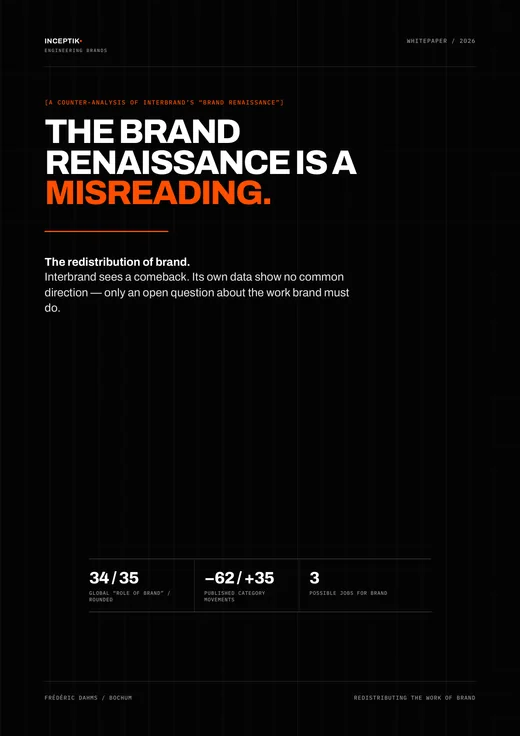
Interbrand calls it a brand renaissance. But a rounded rise from 34 to 35 per cent is not yet an investment case. This report shows you what the evidence can support, which of three jobs matters in your buying process, and how to turn that distinction into testable priorities.
What the published evidence shows
2024 / 2025 / 2026 · rounded
34% / 34% / 35%
Category movements
+35 to −62%
Critical distinction
Finding ≠ mechanism
Source: Interbrand / Paradigm Sample (2026), A Brand Renaissance, Part 1. Category figures are published relative changes; base values, reference period and weighting are not fully disclosed. Open the original report ↗
Interbrand’s explanation is plausible: if algorithms influence choice, familiar brands may gain weight. But the published evidence does not establish that mechanism. It shows a small rise in the rounded global figure alongside markedly different movements across categories.
The sharper question is therefore not whether “brand” is back. It is: What job must brand perform in a particular buying decision – and which part of that job can a system already take on? The report therefore marks each central claim as a finding, an interpretation or an INCEPTIK hypothesis.
Treat those levels as one and a small average can become a blanket investment argument. The report replaces that shortcut with a decision you can explain and test.
The model does not claim certainty. It sets out three hypotheses to test in the buying process that matters to you.
Which option fits our problem? Brand helps buyers place an offer quickly. AI can take on part of the search, screening and comparison. Category, value and difference therefore need to be unmistakable.
Who can we trust with the risk? Brand concentrates experience and evidence. AI can find and compare proof. The provider remains accountable for the contract, liability and support.
What does this choice say about us? Brand can express belonging, values or status. AI can describe or imitate those signals. Shared history and social recognition are not produced by the selection system alone.
The report is written for executive teams and leaders responsible for strategy, marketing and brand – particularly in companies with complex offers, long buying cycles, costly decision risk or several people involved in the choice.
It is for teams that do not need another communications recipe. They need to decide what work their brand must perform in the buying process before they scale content, campaigns and AI-assisted production.
The outcome is not a blanket recommendation to spend more or less on brand. It is a reasoned decision about where positioning, proof or meaning deserves priority – and where it does not.
The Brand Renaissance Is a Misreading.
The report moves from the published finding to three testable hypotheses and a diagnostic protocol for your next investment decision.
Complimentary report · 15 pages
Fifteen pages for one investment question: what work should brand still do? Confirm your address to receive a personal download link, valid for 48 hours.
Almost there.
Open the confirmation email now. Your personal download link will follow immediately.